
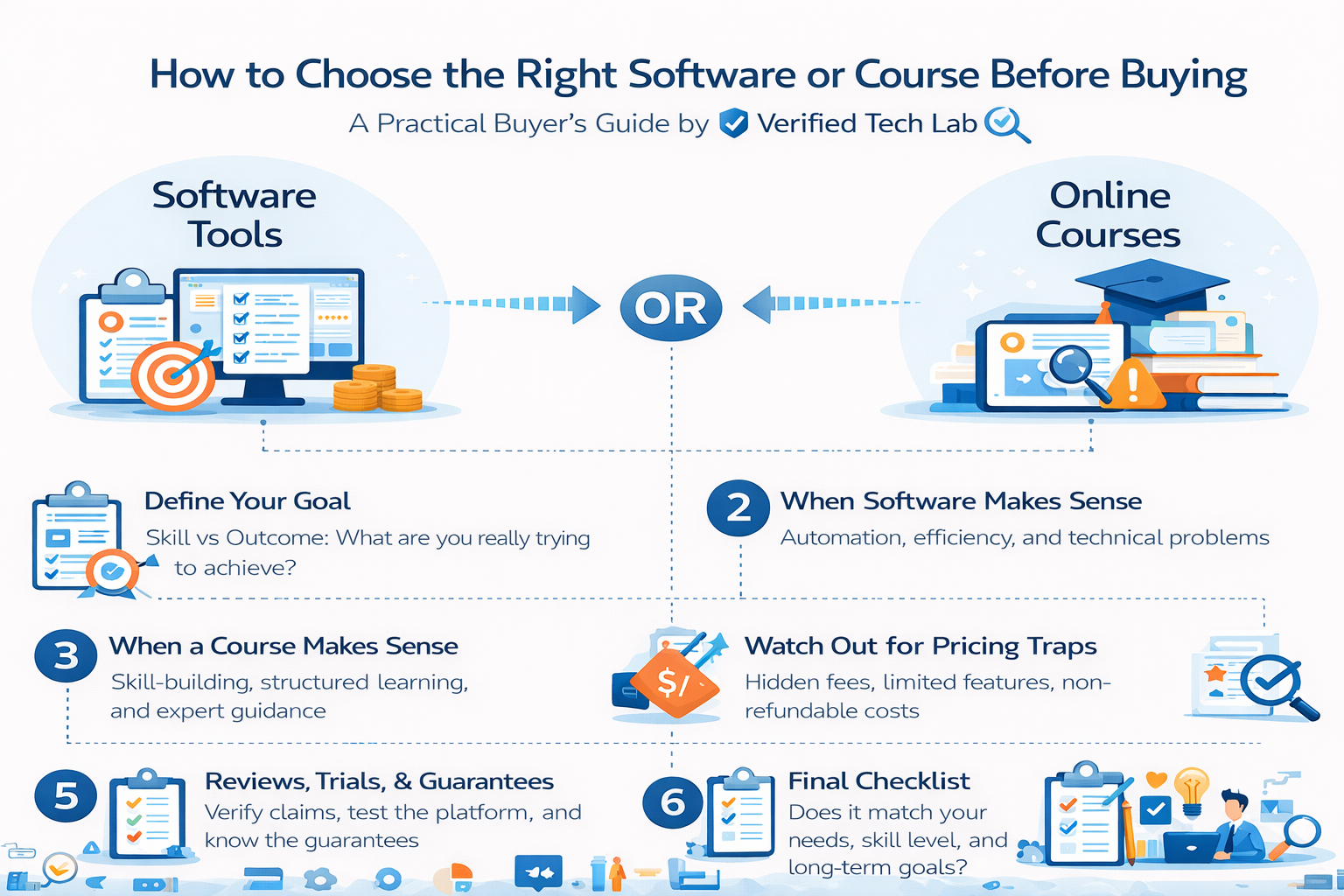
Choosing the right software or online course has become increasingly difficult.
With endless tools, platforms, and courses promising faster growth, better skills, or instant results, many buyers end up confused — or worse, disappointed after spending money on the wrong solution.
At Verified Tech Lab, we believe better decisions come from clarity, not urgency.
This guide is designed to help you think critically before investing in any software or online course.
Why Choosing Software or Courses Feels Confusing Today
Most digital products are marketed aggressively.
Sales pages often focus on outcomes without clearly explaining:
- Who the product is actually for
- What prerequisites are required
- What limitations exist
- Whether it fits your specific goal
As a result, many users buy tools or courses that don’t align with their real needs.
Step 1: Start With the Problem, Not the Product
Before looking at features or testimonials, ask yourself:
- What exact problem am I trying to solve?
- Is this a skill gap, a process issue, or a time constraint?
If your challenge is lack of knowledge, a course may be more suitable.
If your challenge is execution or automation, software might be the better choice.
Clarity at this stage prevents unnecessary purchases later.
Step 2: When Software Makes Sense
Software is usually the right choice when:
- You already understand the basics
- You need to automate or streamline tasks
- You want consistency and efficiency
- You are solving an operational or technical problem
Before buying software, evaluate:
- Ease of use
- Integration with existing tools
- Ongoing costs and upgrades
- Customer support and documentation
Software should reduce effort — not add complexity.
Step 3: When a Course Makes Sense
Courses are more effective when:
- You’re building a new skill or foundation
- You need structured learning
- You want expert guidance or frameworks
- You’re early in the learning curve
Before enrolling in a course, check:
- Who the course is designed for
- Teaching depth versus marketing promises
- Practical application versus theory
- Update frequency and content relevance
A good course empowers you to make better decisions — not just follow instructions.
Step 4: Watch Out for Pricing Traps
Both software and courses can include hidden costs.
Be cautious of:
- High renewal fees after discounts
- Limited features behind expensive upgrades
- Non-refundable purchases
- Long-term commitments without trials
Always review pricing pages carefully and understand what you’re paying for beyond the initial offer.
Step 5: Trials, Refunds, and Guarantees Matter
Reliable platforms usually offer:
- Free trials
- Money-back guarantees
- Transparent refund policies
The absence of these doesn’t always mean low quality — but it does increase risk.
Whenever possible, test before committing.
Step 6: Use Reviews Wisely
Reviews can be helpful, but only when used correctly.
Look for:
- Balanced pros and cons
- Clear use-case explanations
- Honest limitations
- Comparisons, not just praise
Avoid relying solely on:
- Overly promotional testimonials
- Screenshots without context
- Claims that promise guaranteed results
Step 7: Ask One Final Question Before Buying
Before making any purchase, ask:
Will this software or course still be useful after the initial excitement wears off?
Long-term value matters more than short-term motivation.
Final Checklist Before You Buy
Before investing in any software or course, confirm that:
- It solves a clearly defined problem
- It matches your current skill level
- The pricing is transparent
- Reviews are balanced and credible
- The platform aligns with your long-term goals
Final Thoughts
There is no universally “best” software or course — only the right fit for your needs.
At Verified Tech Lab, our goal is not to push products, but to help you make confident, informed decisions based on clarity and real-world evaluation.
Verified Software. Trusted Learning.